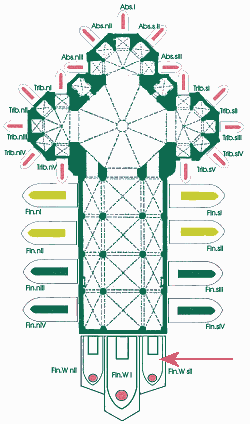
 LOCATION:
Firenze, Cattedrale di S. Maria del Fiore. Façade, window W s II (oculus).
| TUSCANY - Florence |
| FILE : Cathedral 10 |
| TITLE : St. Stephen |
LOCATION:
Firenze, Cattedrale di S. Maria del Fiore. Façade, window W s II (oculus).
PROVENANCE: original location
DIMENSIONS:
CHRONOLOGY: 1412-15 (documented).
AUTHOR: Niccolò di Piero Tedesco on Lorenzo Ghiberti’s cartoon
ASSIGNMENT: Opera del Duomo.
SUBJECT: St. Stephen enthroned surrounded by Angels. The window is framed with a vegetal motif border.
CRITICAL NOTES: The works at this window are all well documented in the archive sources and mentioned by Ghiberti himself in his Commentari. In fact, among his works he cites the main oculus in the façade (1405) and the two on the sides with St. Stephen and St. Laurence ("…disegnai nella faccia di S. Maria del Fiore nell’occhio di mezzo l’Assumptione di Nostra Donna e disegnai gli altri (che) sono dallato…"- I drew the Assumption and other two ocula on the sides of S. Maria del Fiore façade-) proceeding in the list of other later windows - the ones for the Tribunes and Chapels (1435-43) – and those made in the last period for the drum of the dome (1443-35) with the Presentation at the Temple, the Oration in the Garden and the Ascension of Christ.
To those three groups of works made through four decades it seems to correspond three different stages in the evolution of the artist’s formative course. The three ocula for the façade seem to belong to a late gothic stage. Instead, the thirty windows of the transept belong to a period when he is open to introduce more updated elements; the ocula of the dome show a further mature style, inclined to ‘monumentalize’ the figures.
Those three stages in Ghiberti’s painting activity – often ignored or underrated (Lane) – are perfectly modelled on the artist’s general development, as it can be summed up looking at some of his more outstanding works as a sculptor, starting from the Northern Gate of the Baptistery (1401-24), through the statues at Orsanmichele with St. John the Baptist (1412-16), St. Matthew (1419-22), St. Stephen (1425-28) and the two relieves for the font in Siena (1417-27), up to the Gate of Paradise (1425-52). Thus, important echoes of that evolution can be found in the contemporary windows , in the way he set ‘plastically’ the figures, in the use of the line now constructive, now decorative, and in the way he renders the space and perspective.
This window belongs to an initial stage , between 1412 and 1415 by Niccolò di Piero Tedesco, contemporary to the realization of the ‘twin’ ocula with St. Laurence. Ghiberti had collaborated before with that master glazier for the works at the main oculus with the Assumption (1405).
Despite ten years passed between the two works, they have several stylistic and technical characteristics in common: first, the linear refinement that recurs in parts where the sign appears to be more dynamic and taut; then in others, where it unfolds in rhythmic movements.
Similar is also the scheme through which the areas of linear tension and relaxation are located, focusing on broken, cracked and sharp lines in the peripheral areas (wings of angels, back folding of the draperies), as starting points for the wide and solemn unfolding of the waves that recur in the rich mantle of the Saint, he himself an enlarged figure especially if compared with the slight exedra-like architecture of the gothic throne.
Furthermore, the affectation as in the punched haloes , the effect of the ‘shade on shade’ in the Saint’s light blue standard that seems melting in the colour of the sky (an effect dear also to the decorators at Orsanmichele), or the rich carving –like work in the ‘a fioroni’ motif of the figures’ mantles, an element then often pick up in later windows for the Chapels.
Right to the following windows of the Chapels refers the Saint’s pose, sitting but not static, with the right arm holding the standard. Such a pose will be drawn on , with some variations, in all the fifteen windows of the Chapels, where the light architecture of the throne that will transform into a true gothic canopy.
The window is therefore a turning point – together with St. Laurence, its twin – between what was realized and what will be done. On the one hand its stylistic similarities with the Assumption make this window still one of the first stage; whereas on the other hand, some compositive elements seem to foresee the future developments, as it is confirmed even in the sculpture: St. Stephen at Orsanmichele, more updated because it comes later, seems to be anticipated in the physiognomy an in the gesture by the window in subject.
Rejecting all the precious elements and the ‘mannerisms’ of the late gothic, Ghiberti the painter puts himself in that movement of renovation felt in the Florentine culture, spanning between the end of the XIV and the beginning of the XV; a movement that indicated the way to go beyond the Giottesque tradition, deemed then obsolete, through the approach to the late gothic world. In the years, Ghiberti will be able to merge and balance such roots, at times even alternating them, with some of the news coming from the Florentine Humanists, either going back to the solid anatomy of the figure , or to the perspective rigour for the space.
CONDITIONS: The cathedral windows underwent continuous damages and mantainance works. From ancient sources there is prove of the two side ocula restoration carried out before 1433 by Francesco di Giovanni named ‘il Lastra’ and Bernardo di Francesco, two famous master glaziers already active since 1418 in the restoration of the naves windows and then cited as the artists of Ghiberti’s windows in the transept Tribunes and Chapels and for those – again lead to Ghiberti – realized for the third glazing activity at Orsanmichele (Finiello Zervas).
The two main restorations were carried out by U. de Matteis between the XIX and the XX century and by Ditta Tolleri in the postwar period (1946-57). To those interventions is due the most part of the lead framing replacing, of the glass tesseras and some important pieces in the reading of the work, such as hands and faces of the figures.
As shown in the recent restorations carried out in the last years at the Chapels and the dome windows by Studio Polloni in Florence, the outer sides of the glasses manifest the corrosion in act due to impurities and to humidity. The same surveys and care are likewise advisable also for this façade windows in order to prevent their deterioration, through the recovering of the surfaces and their protection with counter-windows to create an isothermal glazing.
It is advisable also an analysis of the deterioration state of the grisaille painting, that in various parts appear to be faded away, with a consequent impossible reading of the figures.
The cracked tesseras also should be recomposed, more cracked here than elsewhere, and the lead webs of containment should be eliminated – especially the ones that cut the faces or the haloes of the Angels, St. Stephen’s head and hands - followed by painting integrations are without heating , and furthermore, the mapping of all the replaced tesseras in the previous restorations referred to the graphic of the lead framings planning.
BIBLIOGRAPHY: vedi Bibl. FIRENZE –GHIBERTI.
PHOTOGRAPHIC FILES:
EDITOR: Marina Del Nunzio (December 2000).