 LOCATION:
Firenze, Cattedrale di S. Maria del Fiore
| TUSCANY - Florence |
| FILE : Cathedral 15 |
| TITLE : St. Andrew |
LOCATION:
Firenze, Cattedrale di S. Maria del Fiore
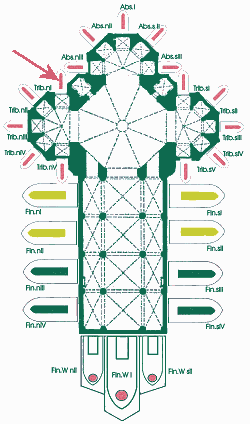
Northern tribune, window n I, S. Andrew Chapel (two-lancet-w.).
PROVENENCE: original location.
DIMENSIONS: 400 x 190 (misure stimate con la vetrata in situ).
CHRONOLOGY: 1442-43 (recorded).
AUTOR: Guido di Niccolò on a decorative project by Lorenzo Ghiberti.
ASSIGNMENT: Opera del Duomo.
SUBJECT: ab 5-8 S. Andrew enthroned in a canopy. Inscription S(an)C(tu)S ANDREAS APPO(stolus).
CRITICAL NOTES: The window is mutilated and, of the original, only the figure of St. Andrew enthroned is left, whilst the lower part - representing two saints in analogy with the other 14 windows of the Duomo chapels – was destroyed in 1722, when the Michelangelo Pietà, once in the choir, was moved to the chapel. The window now has rectangular white panels, veiled, lead soldered.
The execution was assigned to Guido di Niccolò, a master glazier that, together with his collaborators, had worked at the northern tribune. He was the author of the window with St. Thomas, in the southern tribune (1443), and son of that Niccolò di Pietro Tedesco, the author of the ocula in the façade, the central with the Assumption (1405) on Ghiberti’s cartoon – maybe in collaboration with Mariotto di Nardo (Boskovits) – and the ones on the sides with St. Laurence and St. Stephen.
Ghiberti also sketched some cartoons for the chapels, following the various stages of the execution, aiming to obtain a total homogeneous effect as much as possible in spite of the presence of several glaziers: harmonious effect achieved thanks to a colouristic, structural and iconographic references and a subtle calculation of the visual and luminous impact of each window in relation to their collocation and lighting.
Some details seem to be Ghiberti’s, such as the way the depth lines are highlighted, with objects placed on scaled planes (the book, the cross), or the proportional layout of the same slender figure, with falling shoulders and the excessive stretching of the right arm that holds a cross, a "sign" that may be found in many of his stained-glass windows , starting with the St. Laurence and St. Stephens’ of the façade, to the ones in the chapels with St. Barnabas and St. Stephen (even though much integrated), St. Jacopo , St. Matthew and, with a slight variation, with St. Bartolomew, to stress the idea of unity in the complex .
Careful is also the definition of the gothic canopy, an element that highly connotes the work and makes it part of a well defined typology with a long tradition, especially in central Italy. Evidence of that are the Assisi Basilica, the Grottaferrata Abbey, S. Croce and S. Maria Novella in Firenze, the Certosa of Galluzzo, the same naves of the Florentine cathedral, St. Domenic in Perugia, the cathedral of Prato, all in a period of time that goes from the last decades of the XIII , to halfway through the XV century.
Unfortunately, the lower part of the window is lost, exactly where Ghiberti had inserted (in analogy with what can be noted in the other 14 windows of the chapels) an innovating element, contradictory to the upper part: the "box" of the less important figures must have been a plain setting , clearly represented in its simple architectonic parts thanks to the linear prospective. The contradiction of the two parts well reflected the Author’s complex culture, between tradition and innovation and also at the beginning of the crisis of the canonical typology that, from the second half of the XV century, will depart more and more from the, by that time, outdated gothic to introduce an architectonic organization that refers to the classical models.
CONDITIONS: All the Cathedral stained glass windows have undergone a through restoration and integration work, of which considerable is the latest, executed by U. de Matteis of Bruschi’s glasswork (end XI – beginning XIX century) and by Studio Tolleri in Florence (1946-1957).
The most recent intervention was led by Prof. S. Papucci, A. Beccatini and R. Cappelletti of Studio Polloni in Florence, concluded in May 1989.
The dissembling was made with great care as the stained glass was without frame. On the outer side of the glasses deposits have been found, at times also biotic elements that, together with humidity, is the cause of the present corrosion of the glass. The deposits have been washed off with distilled water, compresses of E.D.T.A., ammonium carbonate and scalpel for the cavities. To protect the glass, a blend of healed linseed oil and beeswax was spread on the surfaces .On the inner sides the black smog deposits have been cleaned with compresses of ammonium carbonate in solution. Then, the polishing of the lead frames – they turned out to be not the originals but made in the restorations of the XIX-XX century – and the soldering of the parts broken.
The crevices in the tesseras have been stuck with U.V. ray photosensitive resins, occasionally with shaped pieces of colourless glass, and then painted without heating process. All the painting integrations are without heating.
The stained glass window has a frame and a counter-frame to protect and isolate it from external humidity, thanks to the isothermal glazing.
The whole work has been documented with reports, graphic and photos surveys, also with a scheme of the previous integrations.
BIBLIOGRAPHY: see Bibl. FIRENZE –GHIBERTI.
PHOTOGRAPIC REF.:
EDITOR: Marina Del Nunzio (October 2000).