 LOCATION:
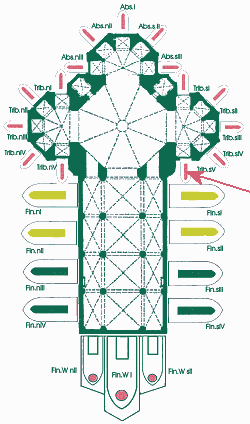
Firenze, Cattedrale di S. Maria del Fiore. South Tribune , window s V, SS.
Vittore and Barnabas Chapel (two lancet w.).
| TUSCANY - Florence |
| FILE : Cathedral 17 |
| TITLE : St. Barnabas and two Saints. |
LOCATION:
Firenze, Cattedrale di S. Maria del Fiore. South Tribune , window s V, SS.
Vittore and Barnabas Chapel (two lancet w.).
PROVENANCE: original location.
DIMENSIONS: cm. 700 x 190.
CHRONOLOGY: 1441-2 (documented: settled 31/10/1441; completed 5/6/1442).
AUTHOR: Bernardo di Francesco on Lorenzo Ghiberti’s decorative project.
ASSIGNEMENT: Opera del Duomo.
SUBJECT: a 1-4 Saint; b 1-4 Saint (woman); ab 5-9 S. Barnabas enthroned in a canopy. Inscription SANTVS BARNABAS.
CRITICAL NOTES: After making the cartoons for the ocula on the façade, with the Assumption (1405) –maybe in collaboration with Mariotto di Nardo (Boskovits)- and the side ones, with St. Laurence and St. Stephen (1512-1415), Lorenzo Ghiberti worked out a vast iconographic programme between 1435 and 1443 for the cathedral tribunes ad the chapels, depicting prophets, kings, apostles, the Virgin and Child, with a complex iconic scheme aimed –as proposed in some studies (Acidini Luchinat) – at celebrating Christ’s genealogy.
Even though Ghiberti’s painting activity is still passed over, in some documents there is evidence of Ghiberti’s intervention for the cartoons of many windows , whilst for others, he choose collaborators, among them comes out the name of Giovanni dal Ponte (Poggi/Haines, II, pp.195-197). Yet, it can be said that a sensible influence of the artist is revealed in all the windows (totally 30), and they seem to be conceived to follow a strict unity of composition and style.
All the windows of the chapels belong to the same iconic typology with an architectonic organization of the figures: the two saints of the lower register are set in a small space, whose perspective is defined and closed by a gothic two-lancet window in the background. The saint in the upper register, titular of the chapel, is enthroned under a complex foreshortened gothic canopy .
It is an original interpretation of the scheme with canopies that Ghiberti enriches: introduced in Italy in the 70s of the 13th century (windows of both the French style and St. Francis’ Maestro groups in the Assisi Upper Basilica) and quickly developed in the first decades of the XIV cent. - examples: Grottaferrata (1300 ca.), St. Ludovic and St. Catherine chapels in the Assisi Lower Basilica (post 1317), Bardi and Tosinghi Spinelli chapels in S. Croce in Firenze (1325 ca.) -, such typology quickly underwent a gradual transformation into gothic since the 30s of the XIV century.
Besides, there is also a process of "rendering images more concrete" , in order to compare the models to the real contemporary architectural ones (see the following Fiorentine exs.: Baroncelli chapel in S. Croce by Taddeo Gaddi (1332-38); Strozzi chapel in S. Maria Novella by Nardo di Cione (1360-70); S. Croce apse by Agnolo Gaddi (1380); Certosa del Galluzzo chapel by Niccolò di Pietro Gerini (1395 ca.).
Such a process of monumentalization and study of three-dimensional space will reach its peak with the nave windows in S. Maria del Fiore, but especially in that by Antonio da Pisa (1395) (see Firenze Cattedrale 11), and in that for St. Domenic in Perugia by Mariotto di Nardo (1411) (see Perugia C. di S. Domenico 1), continuing then –in Umbria and Toscana- until the end of the century .
Ghiberti takes part in that school freely, maybe thanks also to the teaching of Mariotto di Nardo. He added to the typology innovation and creativity, inserting compositive elements –as for instance in the cubature of the lower space, made through the linear perspective- that merge in the Florentine Humanistic culture, but without forgetting the visual impact, still of a clear gothic flavour.
Besides, that appears to be a constant characteristic in Ghiberti’s art, succeeding in making coexist an opening towards the experiences of the new movements in Florence with the search for elegant linear rhythms and for naturalistic details of the International Gothic.
Even in this window, from a stylistic point of view, on one side the figures reveal a monumental composure and a more concrete attention if compared to the models of the earlier windows for the ocula on the façade; on the other side, the fine attitudes, the elegant length of the limbs, the abstract fluctuation of the drapes, the preciousness of both the chromatic choice and the technical devices to simulate the rich vests, all that refers to the gothic world.
What is missing of the Late Gothic is the care for the detail, as the works have been conceived to be seen from a certain distance , and studied most in their chromatic values and in the relation of shades, largely varying according to the location of the window. The last element shows how such works were "born" as stained-glass windows and not as mere representations of a pictorial image on the glass .
Worthy of notice is St. Barnabas’ right arm, stretching out, supporting the attribute, elegant "sign" often recurring in Ghiberti’s works, as for example in the St. Laurence and St. Stephen for the ocula in the façade (1412-15), in St. Paul of the homonymous chapel in the apsidal tribune, in St. Andrew, in St. Stephen –even though much has been inserted-, in St. Jacopo and in St. Matthew in the northern tribune and, with a slight difference, in the St. Bartolomew of the northern tribune, so that the chapels have been said to be derivations from only one cartoon, stressing in this way the idea of a unitary decorative plan. That "sign" can also be found in some sculptures of the Maestro as, for instance, St. Stephen for Orsanmichele in 1428.
As far as iconography is concerned, new theories have come out recently (Acidini Luchinat) for the identification -following the Legenda Aurea- of the first rank saints, generally linked with the titular saint: in this case the two figures have been recognised as St. Miniato e St. Reparata, protectors of Firenze.
CONDITIONS: All the Cathedral stained glass windows have undergone a through restoration and integration work, of which considerable is the latest, executed by U. de Matteis of Bruschi’s glasswork (end XI – beginning XIX century) and by Studio Tolleri in Florence (1946-1957).
The most recent intervention was led by Prof. S. Papucci, A. Beccatini and R. Cappelletti of Studio Polloni in Florence, concluded in May 1989.
The dissembling was made with great care as the stained glass was without frame. On the outer side of the glasses deposits has been found, at times together with biotic elements that, together with dampness, are the causes of the present corrosion of the glass. The deposits have been washed off with distilled water, compresses of E.D.T.A., ammonium carbonate and scalpel for the cavities. heated linseed oil blended in beeswax was spread on the sides in order to protect the glass. On the inner sides the black smog deposits have been polished with compresses of ammonium carbonate in solution. Then, the cleaning of the lead framing – that came out to be not the originals but made in the restorations of the XIX-XX century – and the soldering of the joints broken.
The crevices in the tesserae have been glued with U.V. ray photosensitive resins, occasionally with shaped pieces of colourless glass, and then painted without heating process.
Note that most of the integrations made in the previous restorations are almost all in the lower register, whilst St. Barnabas appears to be almost completely the original, among the few with the face not replaced.
All the painting integrations are without heating.
The stained glass window has a frame and a counter-frame to protect and isolate it from external humidity, thanks to the isothermal glazing.
The whole work has been documented with reports, graphic and photos surveys, also with a scheme of the previous integrations.
BIBLIOGRAFIA: vedi Bibl. FIRENZE – GHIBERTI.
REF. FOTOGRAFICHE:
ESTENSORE: Marina Del Nunzio (luglio 2000).