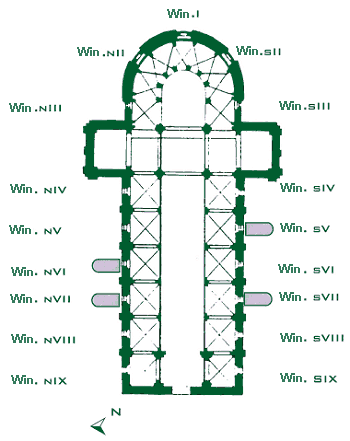
| TOSCANA - Firenze |
| FILE : C. di S. Maria Maddalena de’ Pazzi 1 |
| TITLE : St. Lawrence |
LOCATION: Window nVI - Tornabuoni Chapel, dedicated to the wife of Lorenzo Tornabuoni, Giovanna degli Albizzi Tornabuoni, who died young.
DIMENSIONS: 270 x 200 cm.
PROVENANCE: original location
CHRONOLOGY: c. 1491
AUTHOR: Design by Domenico Ghirlandaio (attribution); execution by Alessandro Agolanti (documented)
PATRON: Lorenzo Tornabuoni
SUBJECT/I: St. Lawrence with a grate, his attribute; he stands in a barrel vaulted niche; in the panel at the bottom of the window two putti hold the Tornabuoni coat of arms.
CRITICAL NOTES: Documents published by Luchs (1977) confirm that the stained glass window was conceived as an integral part of the chapel’s decoration..
Alessandro Agolanti, who lived from 1443 to 1516, was one of the most esteemed glaziers working in Florence at the end of the fifteenth century and the beginning of the sixteenth century. He was the son of Giovanni Agolanti d’Andrea and, like his father, was "Bidello" [caretaker] at the University (1478-1515). Alessandro was assiduously employed in numerous workshops and, in primis, that of Florence’s Duomo. At the same time, around 1480 through 1490, he was carrying out stained glass windows for the Duomo di Lucca and, in Florence, for the church of Santo Spirito and for Palazzo Vecchio. He was the trusted glazier of the Tornabuoni family, from whom he had various commissions around 1491, the most prestigious of which was the execution of the apse window for the High Chapel of S. Maria Novella, known as the "Tornabuoni Chapel" (see Firenze C. di S. Maria Novella 3). He was also commissioned four stained glass windows for the sanctuary of S. Maria delle Carceri see Prato c. di S. Maria delle Carceri 1,2,3,4.
Although Agolanti was one of the most important glaziers in Florence during the last decade of the fifteenth century, his artistic personality has not be the subject of specialized studies. A monograph on this artist has been long-awaited.
CONDITION: In good condition, with some nineteenth-century replacements.
BIBLIOGRAPHY:
A. LUCHS Cestello. A Cistercian Church of the Florentine Renaissance, New York, 1977, pp. 21-23;
ID Stained Glass above Renaissance Altars:figural Windows in Architecture from Brunelleschi to Bramante, in "Zeitschrift für Kunstgeschichte", 48, 1985, pp.177-224;
ID The Convent of Santa Maria Maddalena de’ Pazzi and its Works of Art,Firenze , 1990, p.21, 23
J.K. CADOGAN Domenico Ghirlandaio - Artist and Artisan, Yale Univ., 2000, cat. N.52, pp. 281-82.
PHOTOGRAPHIC REFERENCE: CVMA-Italia archives
EDITOR: Renée K. Burnam February 2003