 LOCATION:
Firenze, Cattedrale di S. Maria del Fiore
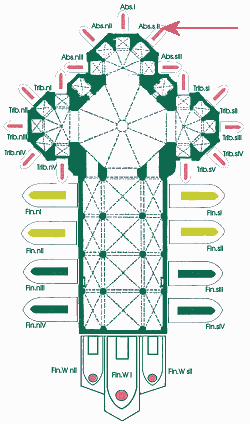
Apsidal tribune, aps. window s II, St. John Evangelist chapel (two-lancet w.).
| TUSCANY - Florence |
| FILE : Cathedral 20 |
| TITLE : St. John Evangelist and two Saints |
LOCATION:
Firenze, Cattedrale di S. Maria del Fiore
Apsidal tribune, aps. window s II, St. John Evangelist chapel (two-lancet w.).
PROVENANCE: original location.
DIMENSIONS: cm. 700 x 190.
CHRONOLOGY: 1441-1443 (recorded: commission inl September 1441).
AUTHOR: Biagio di Agnolo Lippi on a decorative plan by Lorenzo Ghiberti.
ASSIGNEMENT: Opera del Duomo.
SUBJECT: a 1-3 Saint; b 1-3 Saint; ab 4 –7 St. John Evangelist enthroned in a canopy. Inscription: S. IOA(n)ES EVANGELISTA.
CRITICAL NOTES: The stained glass window was commissioned in 1441 and finished by 1443, year when all the windows of the Cathedral Tribunes and Chapels had to be completed, according to the decoration planned by Ghiberti aiming to exalt Christ’s geneology (Acidini Luchinat).
The work was by Biagio di Agnolo Lippi, in collaboration maybe with his father, as Biagio was given the commission, but Agnolo Lippi was paid for it . Besides, the same Agnolo was working at the Cathedral yard and he turned out to be the author of the St. Peter window, as it can also be read in the inscription at the bottom.
As for the style and the structure, highly homogeneous is that of the all 30 stained glass windows both of the Tribunes and the Chapels, result of Ghiberti’s work, author himself of some cartoons, supervisor of the whole work, in spite of technical contribution given by other collaborators.
That supervision was based on stylistic links, through visual effects such as the details in the Saint’ red cloth with large green flowers, motifs that refer to others similar ones in sumptuous mantles, almost alike in some stained glass windows, with some differences both in the colours and in the drawings in others (see for example St. Barnabas, St. Zanobi, St. Peter, St. Matthew).
Moreover, Ghiberti had already drawn cartoons for the ocula in the façade, the central one with the Assumption (1405) –maybe in collaboration with Mariotto di Nardo (Boskovits). The side ones with St. Laurence and St. Stephen (1412-15), showing more care to chromatic modulations and a fine tone matching.
That tendency is again shown in the stained glass windows of the transept, studied and planned with no extreme care for details, as they had to be seen from a certain distance. Attention was given mainly to their colour values, to the tone matching that recurs from one window to another, with variations that seem to depend upon the window location and exposure. Such refinement and planning manifest that the works were "born" to be stained glass windows , not simply pictorial images transposed on the glass.
If not Ghiberti as an "artist" – a man with a complex culture in balance between two incommunicable worlds, the late gothic and the humanism - certainly Ghiberti as a "glazier" may have been influenced by the tradition represented in the person of Mariotto di Nardo as, mainly on the iconographic choice, besides figures set in a ‘Florentine’ prospective space, he places a Titular Saint of the Chapel in a canopy that clearly hints at the gothic style. Then, the idea for the typology refers to the stained glass window by Mariotto di Nardo(1411), at St. Dominic in Perugia (see Perugia Church of St. Domenic 1) where both the foreshortening and space were combined to search for elegance and similarity of the structure with that of the real gothic architecture.
In fact, Mariotto di Nardo can be considered the follower of a long iconographic tradition that, coming to Italy at about 1270 (Assisi, Upper Basilica, French style and St. Francis Master stained glass windows group), quickly spread around (see the examples of Grottaferrata (1300), Bardi, Tosinghi Spinelli Chapels(1325) , Baroncelli (Taddeo Gaddi 1332-38) S. Croce apse ( Agnolo Gaddi 1380), S. Maria Novella (Nardo di Cione 1360-70), Galluzzo Charterhouse (Niccolò di Pietro Gerini 1395), up to reaching its highest perfection in the Fiorentine cathedral windows on cartoons made by Agnolo Gaddi, and in the window by Mariotto in Perugia, exemplar for its monumentality and lightness at the same time.
Ghiberti then picks all that up but, inserting his perspective "box", he represents the start of the crisis, the transitional passage towards the following break up, when Renaissance architectonic models will gradually take the place – except for Umbria- of the updated gothic pointed arches, vaults, ribs, spires and pinnacles.
As far as iconography is concerned, the two Saints of the lower register have been identified as – thanks to the precious stones in their hands, cited in the Legenda Aurea- Atteo and Eugene young men converted by the Evangelist, in the act of rejecting wealth (Acidini Luchinat).
CONDITIONS: All the Cathedral stained glass windows have undergone a through restoration and integration work, of which considerable is the latest, executed by U. de Matteis of Bruschi’s glasswork (end XI – beginning XIX century) and by Studio Tolleri in Florence (1946-1957).
The most recent intervention was led by Prof. S. Papucci, A. Beccatini and R. Cappelletti of Studio Polloni in Florence, concluded in May 1989.
The dissembling was made with great care as the stained glass was without frame. On the outer side of the glasses deposits has been found, at times together with biotic elements that, together with dampness, is the cause of the present corrosion of the glass. The deposits have been washed off with distilled water, compresses of E.D.T.A., ammonium carbonate and scalpel for the cavities. To protect the glass, a blend of heated linseed oil and beeswax was spread on the surfaces .On the inner sides the black smog deposits have been cleaned up with compresses of ammonium carbonate in solution. Then, the polishing of the lead frames – they turned out to be not the originals but restored in the XIX-XX century – and the soldering of the parts broken.
The crevices in the tesseras have been glued with U.V. ray photosensitive resins, occasionally with shaped pieces of colourless glass, and then painted without heating process.
Note that during the restoration the faces of the figures turned out to be the work of the earlier modern restorations, the same for great part of the tesseras of the minor Saints cloths.
All the painting integrations are without heating.
The stained glass window has a frame and a counter-frame to protect and isolate it from external humidity, thanks to the isothermal glazing.
The whole work has been documented with reports, graphic and photos surveys, with also a scheme of the previous integrations.
BIBLIOGRAFIA: see BIBL. FIRENZE- GHIBERTI.
REF. FOTOGRAFICHE:
ESTENSORE: Marina Del Nunzio (October 2000).