| TUSCANY - Florence |
| FILE : Cathedral 21 |
| TITLE : St Jacob with Ermogene and Filete |
LOCATION: Firenze, Cattedrale di S. Maria del Fiore
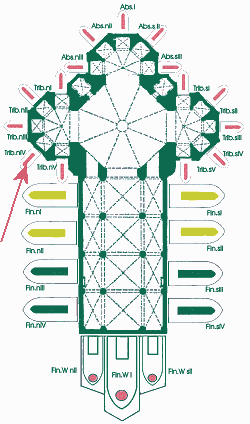
Northern Tribune, window n IV, St. Jacopo the Elder Chapel (two-lancet w.).
PROVENANCE: original location.
DIMENSIONS: cm. 700 x 190.
CHRONOLOGY: 1442-43 (commission 1442).
AUTHOR: Guido di Niccolò and workshop, on a decorative project by Lorenzo Ghiberti.
ASSIGNEMENT: Opera del Duomo.
SUBJECT: a 1-4 Ermogene; b 1-4 Fileto; ab 5-9 St. Jacopo enthroned in a canopy. Inscription: S. IACOPVS APOSTOLVS; HERMOGENES; PHYLETVS.
CRITICAL NOTES: The stained glass window belongs to the last period of the glazing activity in the Cathedral Tribunes and Chapels, dominated in its highest point by Guido di Niccolò’s workshop and his collaborators. The cycle was started in l 1435 and is based on a general drawing plan by Lorenzo Ghiberti – he had already supplied the cartoons for the three façade ocula in 1405 and 1412-15 – aiming to celebrate Christ genealogy (Acidini Luchinat). For such a complex (30 lights), Ghiberti drew some of the cartoons, giving others to some collaborators, among whom pheraps Giovanni dal Ponte (Poggi/Haines, II, pp.195-7).
Furthermore, Ghiberti choose the iconography of the figures container in an architectonic structure, following the already present typology with canopies.
The introduction of the typology in Italy dates to the XIII century ( Assisi Upper Basilica) and quickly developed in all the central Italy, as in the XIV cent. examples of Grottaferrata in Lazio, Umbrian (Assisi Lower Basilica) and Tuscan (Firenze, S. Croce, S. Maria Novella, Certosa del Galluzzo, Duomo), belonging to the work of the great master painters and glaziers of the time, like the Master of Figline, Agnolo Gaddi, Nardo di Cione, Niccolò di Pietro Gerini, Antonio da Pisa, getting to the unrivalled – for ratio and effect – example of Mariotto di Nardo in St. Domenic in Perugia (1411) ( See Perugia , St. Domenic C., 1) . Example perhaps not unknown to Ghiberti if, as suggested by Boskovits, a collaboration between Ghiberti and Mariotto di Nardo has been recognized for the eye in the façade with the Asssumption (1405).
Ghiberti, a man in the transition between Gothic and Renaissance, takes part of this school but starting its crisis: to the traditional gothic canopy of the upper part, he instead opposes a sober setting and rigorously made out by the linear prospective, anticipating the need of updating the typology that will become clearer and clearer in the second half of the century, when the classical taste of the Renaissance will take the place of the obsolete Gothic.
In the canopy, the elegant, long-limbed figure of St. Jacopo, at the same time firm in the volumes and in the space lay out, the same space that is found in other windows such as the St. Paul’s, carried out by Lorenzo di Antonio for the apsidal Tribune. Ghiberti’s ‘sign’ is again present, as in other stained glass windows of the complex, in the excessive elongation of the right arm, recurring in the sections with St. Barnabas, St. Andrew, St. Matthew, St. Bartolomew and St. Paul –executed in different times by Bernardo di Francesco, by the same Guido di Niccolò, by Domenico di Piero of Pisa and by Lorenzo di Antonio – moreover, a stylistic sign already present in the two ocula of the façade with St,. Laurence and St. Stephen (1412-15) and in some sculptures by the Master such as the St. Stephen for Orsanmichele (1428).
Differently from most of the figures of the Chapels’ windows, St. Jacopo doesn’t wear typical vestments with the wide falling of the folds characterized by motifs ‘a fioroni’, but simply with a tunic and a mantle solely supported by the contrasting and deep brilliance between blue and purple. A similar emphasis on the pure chromatic values are to be seen in St. Antonio abbot and St. Thomas of the South Tribune and in the Virgin with the child of the apsidal one.
That confirms the fact that even in Ghiberti’s search for unity, he always takes care of creating little varieties, but overall he conceives each window mostly in its chromatic values and in relation to the displacement of the relative window and to the illumination grade. All that is evidence of how the works were born to be stained glass windows and not mere pictorial images on a transparent medium.
From an iconographic viewpoint, the two saints of the lower register are identified by the inscriptions: Ermogene and his pupil Fileto, two magicians converted by St. Jacopo.
CONDITIONS: All the Cathedral stained glass windows have undergone a through restoration and integration work, of which considerable is the latest, executed by U. de Matteis of Bruschi’s glasswork (end XI – beginning XIX century) and by Studio Tolleri in Florence (1946-1957).
The most recent intervention was led by Prof. S. Papucci, A. Beccatini and R. Cappelletti of Studio Polloni in Florence, concluded in May 1989.
The dissembling was made with great care as the stained glass was without frame. On the outer surface of the glasses deposits has been found, at times together with biotic elements that, together with humidity, is the cause of the present corrosion of the glass. The deposits have been washed off with distilled water, compresses of E.D.T.A., ammonium carbonate and scalpel for the cavities. To protect the glass, a blend of baked linseed oil and beeswax was passed on the surfaces .On the inner surfaces the black smog deposits have been cleaned up with compresses of ammonium carbonate in solution. Then, the cleaning of the lead frames – came out to be not the originals but made in the restorations of the XIX-XX century – and the soldering of the parts broken.
The crevices in the tesserae have been stuck with U.V. ray photosensitive resins, occasionally with pieces of colourless glass purposely shaped, and then painted without heating process.
During the works it came out that the figure of the main Saint is almost totally original, while the other two appeared to be in great part remade, most of all the cloths and the face of the Saint on the left.
All the painting integrations are without heating.
The stained glass window has a frame and a counter-frame to protect and isolate it from external humidity, thanks to the isothermal glazing.
The whole work has been documented with reports and graphic and photos surveys, with also a scheme of the previous integrations.
BIBLIOGRAFIA: see BIBL. FIRENZE- GHIBERTI.
REF. FOTOGRAFICHE:
ESTENSORE: Marina Del Nunzio (October 2000).