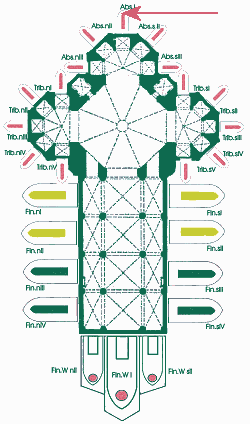
 LOCATION:
Firenze, Cattedrale di S. Maria del Fiore. Apsidal Tribune , apse window I,
St. Zanobi chapel (mullioned window).
| TUSCANY - Florence |
| FILE : Cathedral 26 |
| TITLE : St. Zanobi and two Saints. |
LOCATION:
Firenze, Cattedrale di S. Maria del Fiore. Apsidal Tribune , apse window I,
St. Zanobi chapel (mullioned window).
PROVENANCE: original location.
DIMENSIONS: cm. 700 x 190.
CHRONOLOGY: 1428 (documented: assignment 1428) and following.
AUTHOR: Bernardo di Francesco and Francesco di Giovanni on Lorenzo Ghiberti’s decorative project.
ASSIGNMENT: Opera del Duomo.
SUBJECT: a 1-4 Saint; b 1-4 Saint; ab 5-7 St. Zanobi enthroned in a canopy. Incription CENOBIVS EPISCOPVS.
CRITICAL NOTES: As far as the chronology of the present window is concerned, it turned out to be the most enigmatic among the windows of the chapels in the cathedral. The total remaking of the original work doesn’t allow any theory to be verified.
There is evidence of the work made in a window for the axial chapel of the apsidal tribune from the of the Opera del Duomo ‘s documents. Its realization was already decided in 1428 and assigned to Bernardo di Francesco and Francesco di Giovanni, the former than will also be the author of the windows with St. Barnaba and St. Matthew of the southern tribune(1441-42).
Than the uncertainty of its chronology is clear, as the execution of all the other windows of the chapels on Ghiberti’s project is commonly assigned – proved by sources – to the period 1439-1443.
As for the style and iconography – in spite of the remaking- the window appears to be in line with the ones similar and realized from 1439 to 1443: so this window must not be the original assigned to Bernardo di Francesco and Francesco di Giovanni. Instead, it is supposed to be a "second version" made at the moment of the realization of all the other windows drawn by Ghiberti, may be made by Bernardo di Francesco himself while working at the windows of the right tribune (1441-42)?
That is not easily verifiable for the total remaking of the work: Marchini (note 50 , p. 40) had already singled that out, doubtfully assigning such remaking to the end of the XV century, contemporary to the decoration of the chapel. Prof. Papucci , A. Becattini and R. Cappelletti of the Studio Polloni in Florence, with their more recent survey made in October 1985, even assumed that the remaking dates to the beginning of the XX century, deducing that from the colors and from the stained glass technique. Besides, the presence of "old" tesserae was noticed, clearly belonging to other windows and reused only in function of their chromatic value.
In spite of the doubts about the chronology, it’s clear that they worked in line with the project of the whole complex, so that the result today is a perfect camouflage if compared to the other windows and to the style, composition and chromatic values of the windows left.
The figure of the saint appears pervaded with a fine move that amplifies the definition of the body in oblique, as it appears – but with a opposite orientation – in several windows, such as the ones with the Virgin and Child, with St. John the Evangelist, St. Thomas, while the position of both the pastoral and the book mark the sequence of the plans in the depth, following a very common scheme in Ghiberti’s windows.
Even the colors used are adjusted to the whole and original range, stressing on the contrast between red and green and using – as cross-reference to the rest of the windows – the typical ‘a fioroni’ cloth ,dear to Ghiberti, for all the three figures.
The same for the architecture of the work, that is perfectly coherent with that of the windows, as the clear mixture of the tradition with the gothic canopy and a ‘setting’ where the cubature comes from the linear perspective and with simple architectonic elements.
CONDITIONS: It is likely that this window too was restored by U. de Matteis of Bruschi’s glasswork (end XI – beginning XIX century) and by Studio Tolleri in Florence (1946-1957). In fact, the total remaking is likely to have been due to the first of the two restorations, as from the results of a new restoration by Prof. S. Papucci, A. Becattini and R. Cappelletti of the Studio Polloni in Firenze in October 1985.
On the outer surface of the glasses deposits were found, at times together with biotic elements that, together with humidity, is the cause of the present corrosion of the glass. The deposits were washed off with distilled water, compresses of E.D.T.A., ammonium carbonate and scalpel for the cavities. To protect the glass, a blend of baked linseed oil and beeswax was passed on the surfaces .On the inner surfaces the black smog deposits were cleaned up with compresses of ammonium carbonate in solution. Then, the cleaning of the lead frames – came out to be not the originals but made in the restorations of the XIX-XX century – and the soldering of the parts broken.
The crevices in the tesseras were stuck with U.V. ray photosensitive resins, occasionally with pieces of colourless glass purposely shaped, and then painted without heating process.
In the restoration a further problem with this window was singled out. In fact, on the outer side there was evidence of a darkening element made through the use of the ‘grisaille’ fired, to create an ‘ancient-like’ and filtering effect in order to get to a luminous uniformity of the window with the original ones.
During the work such a layer has been removed, this time in order to bring it neat to the other windows already restored.
All the painting integrations are without heating.
The stained glass window has a frame and a counter-frame to protect and isolate it from external humidity, thanks to the isothermal glazing.
The whole work has been documented with reports and graphic and photos surveys, with also a scheme of the previous integrations.
BIBLIOGRAPHY: see Bibl. FIRENZE- GHIBERTI.
PHOTOGRAPHIC FILEs:
EDITOR: Marina Del Nunzio (October 2000).