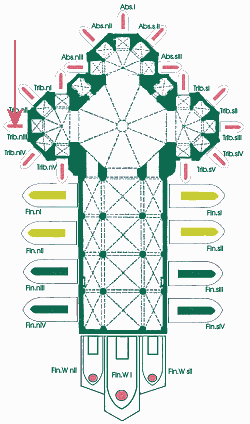
 LOCATION:
Firenze, Cattedrale di S. Maria del Fiore - Northern tribune, window n. I, St.
Stephen’s chapel (mullioned w.).
| TUSCANY - Florence |
| FILE : Cathedral 27 |
| TITLE : St Stephen and two Saints |
LOCATION:
Firenze, Cattedrale di S. Maria del Fiore - Northern tribune, window n. I, St.
Stephen’s chapel (mullioned w.).
PROVENANCE: original location.
DIMENSIONS: cm. 700 x 190.
CHRONOLOGY: 1442 (documented: assignment 31/1/1442).
AUTHOR: Guido di Niccolò and workshop on Lorenzo Ghiberti’s decorative project.
ASSIGNMENT: Opera del Duomo.
SUBJECT: a 1-3 Saint; b 1-3 Saint; ab 4 –7 St. Stephen enthroned in a canopy. Inscription S. STEPHANVS.
CRITICAL NOTES: The window is part of the thirty projected by Lorenzo Ghiberti and realized by various master glaziers between 1435 and 1443 for the Cathedral tribunes and chapels, aiming to celebrate - in a vast iconographic program – Christ’s genealogy (Acidini Luchinat).
Ghiberti drew the cartoons himself of some windows, as he had already drawn the ocula in the façade, with the Assumption (1405), St. Laurence and St. Stephen on the sides (1412-15). Furthermore, he supervised the various glaziers so that the whole work comes up to be homogeneous in the style and colors; characterized by refined thematic and chromatic references from chapel to chapel and overall by uniformity of lighting and a subtle calculation of the windows exposure.
The present window was realized by Guido di Niccolò – master glazier, Niccolò di Pietro Tedesco’s son , the artisti of Ghiberti’s ocula on the façade – and by others of the workshop, such as Lorenzo di Antonio, Carlo di Francesco Zati and Giovanni d’Andrea, that worked in the Northern tribune (see also the windows with St. Andrew and St. Jacopo), besides, they were the author of St. Thomas in the southern tribune.
Already noticed by Marchini for the fact that was almost completely remade in modern times, the stained glass window has been examined again in the recent restoration (see further details). During the works, they found out a tessera , besides the sign with the saint’s name, with the following inscription: "RESTAURATO DA ULISSE DE MATTEIS E N. BRUSCHI NELLO S.(tabilimen)TO FRANCINI E C. U. DE MATTEIS. RIMESSO PEZZI NUOVI 1159. FIRENZE 1883" (‘restored by Ulisse de Matteis and N. Bruschi in Francini and De Matteis’ workshop. 1159 new pieces replaced. Florence 1883’): from the number of pieces replaced, a great work in the quantity is deduced.
In spite of the remaking, is clear that they worked following the original drawing, the stylistic, the compositive and the chromatic values of the whole complex in order to reach a general uniformity with the originals of the other Chapels.
The figure of the Saint seems to recall the lay out in the ocula of the façade with St. Stephen. Once eliminated the superfluity of graphic elaboration and of the folding of the mantle, it comes to a greater and more solid construction. It also presents the characteristic excessive elongation of the right arm, as can be seen in in St. Barnaba, St. Andrew, St. Jacopo, St. Matthias, St. Paul and St. Bartholomew, a common ‘sign’ and referable to the already described St. Stephen and St. Laurence, in the second side ocula of the façade, that recalls to a particular ‘mannerism’ of Ghiberti.
Even the colors, based on clear contrasts of brilliant and deep tones, is coherent with the other windows. The same for the motifs of the cloths, result of Ghiberti’s refined taste in his choice.
Furthermore, the architectural lay out is perfectly coherent with that in the other windows, showing Ghiberti’s characteristic of merging the traditional gothic canopy in the upper part with the lower setting, with its linear perspective and the simplicity of the architectonic elements.
As far as the iconography is concerned, the two deacons of the lower register recall the narration of the Saint’s burying, with the three deacons besides, Gamaliel, Abiba e Nathanael, named Nicodemus (Acidini Luchinat).
CONDITIONS: As said before, the window was in great part remade in 1883 by U. de Matteis , following then the restoration by Studio Tolleri di Firenze (1946-57).
The most resene intervention was carried out by prof. S. Papucci, A. Becattini, and R. Cappelletti of Studio Polloni in Firenze and completed in December 1986.
In disassembling the window it turned out to be made – unique in the complex – with an iron framing heavily damaged, dating to De Matteis’ restoration.
On the outer surface of the glasses deposits were found, at times together with biotic elements that, together with humidity, is the cause of the present corrosion of the glass. The deposits were washed off with distilled water, compresses of E.D.T.A., ammonium carbonate and scalpel for the cavities. To protect the glass, a blend of baked linseed oil and beeswax was passed on the surfaces .On the inner surfaces the black smog deposits were cleaned up with compresses of ammonium carbonate in solution. Then, the cleaning of the lead frames – came out to be not the originals but made in the restorations of the XIX-XX century – and the soldering of the parts broken.
The crevices in the tesseras were stuck with U.V. ray photosensitive resins, occasionally with pieces of colourless glass purposely shaped, and then painted without heating process.
All the painting integrations are made without heating process .
From the test on the window it came out that some important tesseras had been replaced, for instance, the three faces of the Saints, St. Stephen’s hands and his book, the sign with the name and great parts of the three Saints’ cloths. During the restoration all the replaced tesseras and their location were identified.
The stained glass window has a frame and a counter-frame to protect and isolate it from external humidity, thanks to the isothermal glazing.
The whole work has been documented with reports and graphic and photos surveys, with also a scheme of the previous integrations.
BIBLIOGRAPHY: see Bibl. FIRENZE –GHIBERTI.
PHOTOGRAPHIC FILES:
EDITOR: Marina Del Nunzio (October 2000).