| TUSCANY - Florence |
| FILE : Cathedral 30 |
| TITLE : Ascension of Christ |
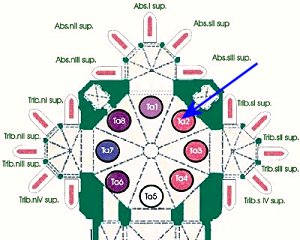
LOCATION: Firenze, Cattedrale di S. Maria del Fiore - Drum of the dome, window Ta 2 (ocula).
PROVENANCE: original location.
DIMENSIONS: diameter 485 cm.
CHRONOLOGY: 1443-44 (documented: assignement 1443).
AUTHOR: Bernardo di Francesco on Lorenzo Ghiberti’s cartoon.
ASSIGNEMENT: Opera del Duomo.
SUBJECT: Ascension of Christ , with Apostles and the Virgin. The window is framed with a large floral bordure.
CRITICAL NOTES: Ghiberti is certainly the most active artist of the stained glass windows in the yard of the Florentine cathedral. The starting of this activity dates to the first ocula in the façade, with the Assumption (1405) – maybe in collaboration with Mariotto di Nardo (Boskovits) – and the side one with St. Laurence and St. Stephen (1412-15), then realized by the glazier Niccolò di Pietro Tedesco. The mature stage is represented in the vast work planned by the Master of the transept Tribunes and Chapels, an iconic cycle with images of Prophets, Kings, Apostles, Saints, the Virgin and Child, aiming to exalt Christ’s genealogy (Acidini Luchinat). That cycle was carried out between 1435 and 1443 and the execution was given to several master glaziers supervised by the same Ghiberti.
Ghiberti – almost at the end of his collaboration at the Florentine cathedral – was assigned of the three ocula in the drum, to be made with the Ascension, Oration in the Garden, Presentation at the Temple, all carried out between 1443 and 1445.
The present ocula was realized by Bernardo di Francesco, active artist also in the cycle of the chapels (windows with St. Barnabas, St. Matthew , St. Zenobi and St. Antony Abbot), where he faithfully followed the ideas of the Master.
Instead, in this work the glazier was less accurate, especially in the matching of the colours, that turned out to be confused and interferes with a right reading of the whole work and its drawing (Acidini Luchinat).
Such a critic weighs upon the value of the result, particularly if one considers that all Ghiberti’s windows were planned thinking of their chromatic references and values, in relation to their location and exposition; they were ‘born’ as stained glass windows, not merely as pictorial images on glass.
In spite of the gap, through that work it is possible to single out a stage of Ghiberti’s evolution as a glazier. Going beyond the more linear and decorative stage of the late gothic, represented in the façade, in the Tribunes and in the Chapels Ghiberti had already shown to be open to the new style, typology and composition ( in the choice of the architecture, and of the figure in the lower registers), coming up to an image still tense and quick but at the same time wider and more measured.
The present window seems to refer to that mixture of linear gothic rhythms and the research of monumentality and pondering. The central figure of Christ, elongated, elegant in his gesture, elaborated in the rhythmical undulations of the drapery but solemn, recalls the figures of the Apostles and the Virgin, greater and foreshortened in order to exalt the full volumes, with slow and rhythmic movements but at the same time refined in the linear and cadenced richness of the mantles.
The same figures of the ocula recall the windows of the Chapels, for some of their deep and brilliant shades like the blue, the red and yellow in the paste and for the details of the precious ‘a fioroni’ cloth on a contrasting background, one of the more recurrent motives so one of the linking elements that are easily noticeable among the several windows in the transept.
Thus, in this work – and especially in the Presentation at the Temple – Ghiberti, an artist between the Gothic and the Renaissance, seems to instil that complex balance between innovation and tradition, a balance reached right in those years of work also in the sculpture, in the precious relieves of the Gate of Paradise at the Baptistery (1425-52) characterized by a rhythm that sometimes is more nervous an superficial, sometimes more constructive and relaxed, and from a linear tension now more melodic and decorative, now more incisive and organized.
CONDITIONS: Besides the constant work of maintenance made through the centuries and sometimes not documented, the Cathedral stained glass windows have undergone a through restoration and integration work, of which considerable is the latest, executed by U. de Matteis of Bruschi’s glasswork (end XI – beginning XIX century) and by Studio Tolleri in Florence (1946-1957). They replaced the lead framings and new tesseras, often corresponding with important parts of the window. In this case, the more evident remaking, made in the 50ties, is Christ’s head.
The most recent intervention was led by Prof. S. Papucci, A. Beccatini and R. Cappelletti of Studio Polloni in Florence, between March and December 1999.
The dissembling was made with great care as the stained glass was without frame. On the outer surface of the glasses deposits were found, at times together with biotic elements that, together with humidity, is the cause of the present corrosion of the glass. The deposits were washed off with distilled water, compresses of E.D.T.A., ammonium carbonate and scalpel for the cavities. To protect the glass, a blend of baked linseed oil and beeswax was passed on the surfaces .On the inner surfaces the black smog deposits were cleaned up with compresses of ammonium carbonate in solution.
Particularly problematic turned out to be the work on the Apostles’ heads, all with double glazing, inserted during a past restoration, painted in order to complete the features of the faces washed away in the original glasses. The presence of those double glazing caused the accumulation of filth between the same glasses and the original ones. As a consequence, the faces of the figures were blackened: the double glazing was removed in order to clean them and the original glass as well. Then, they were reassembled because of their utility and as they are now historically acquired. Anyway, a new lead framing was made in order to obtain a better soldering in the tesseras, avoiding another possible amounting of dirt.
Afterwards, they analysed the lead framing, the soldering and made a new outer framing.
The crevices in the tesseras were all stuck and possible webs of the lead framing. The breaks were set with U.V. ray photosensitive resins. When there were smaller crevices, they used pieces of colourless glass purposely shaped and silicone resins for the gluing. , and then painted without heating process.
The integration of all the missing tesseras was made after the sampling of the grisaille and veiling, and all the new tesseras were signed "P".
All the painting integrations are without heating.
The stained glass window then replaced in a reinforced frame has also a counter-frame made of brass and crystal in order to protect and isolate it from external humidity, thanks to the isothermal glazing.
The whole work has been documented with reports and graphic and photos surveys, with also a scheme of the previous integrations during the present and previous restorations, according to the CVMA conventions.
BIBLIOGRAPHY: see Bibl. FIRENZE –GHIBERTI.
PHOTOGRAPHIC FILES:
EDITOR: Marina Del Nunzio (November 2000).