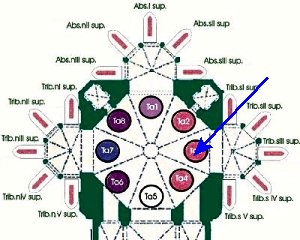
 LOCATION:
Firenze, Cattedrale di S. Maria del Fiore. Tambour, window ta 3 (roundel).
| TUSCANY - Florence |
| FILE : Cathedral 4 |
| TITLE : Prayer in the Garden |
LOCATION:
Firenze, Cattedrale di S. Maria del Fiore. Tambour, window ta 3 (roundel).
PROVENANCE: original location.
DIMENSIONS: diametre 470 cm.
CHRONOLOGY: 1443-44 (documented).
AUTHOR: Bernardo di Francesco on Lorenzo Ghiberti’s cartoon.
ASSIGNMENT: Opera del Duomo.
SUBJECT: Christ’s prayer in the Garden with the Apostles asleep. A large bordure with floral motifs and radiant stars frames the window.
CRITICAL NOTES: The work, cited in Ghiberti’s Commentari together with other two roundels for the dome drawn by the Master (Ascension of Christ and Presentation at the Temple), belongs to the last period of his activity as an author of cartoons for the windows of the cathedral.
His activity as a master glazier had started forty years before, with the roundels in the façade, the Assumption in the centre (1405) and the two on the sides with St. Laurence and St. Stephen (1412-15), continuing then (1435-43) with the imposing cycle in the transept referring to Tribunes and Chapels and representing Christ’s genealogy, and finally concluding (1443-45) with the three ocula in the dome.
Therefore, an activity parallel to sculpture and linked to that in the process of maturation of his style, from the initial late gothic – seen as a renovation of the extreme ‘giottesque’ tradition- to the progressive fusion of that style with elements typical of the Florentine Humanism (and overall in Donatello) related to the rendering of both the figure and the space till reaching a mature style where the affectation in the elegance and in the lines are combined with the study of volume and monumental effect.
The execution was carried out by Bernardo di Francesco, also the translator of the other two roundels for the dome by Ghiberti, and already the artist of several windows drawn by the Master for the Chapels.
Striking is the clear lack of proportion in the window – already noticed by Marchini – between the monumental figures and the landscape that does not ‘make the space’: it is detailed, overall in the buildings of the ideal Jerusalem, but there is not a real sense of depth. The same for the various kinds of trees, described in particular, but with an obvious lack of proportion in comparison with the figures. Ghiberti, that in that same time was showing his mastery of the perspective in his work for the Paradise Gate (see i.e. the episode with Salomon meeting the Queen of Saba), in this case he does not represent a ‘measured space’ but continues with the ‘late gothic enumeration’: lingering over the detail he forgets the vision of the whole image, creating an unrealistic one, with fable-like tones and a suspended atmosphere.
Thus, the window seems to reflect the complex character of Ghiberti’s culture very well, always transitional between past and present, but always paying attention to calculate the effect, even the expressive feature: in this work, for instance, the figures of Christ and the Apostles seem to be sketched in differently to point out their different inner life.
In fact, on one side there is the figure of Christ, leaning forward, with an oblique posture which tension seems to be amplified by the deep folds of the drapery and their ‘sharp’ falling, that Ghiberti had already used since the time of his three ocula in the façade to express dynamism; on the other, there are the Apostles on the right that with their heavy and motionless bodies, little defined, suggest the idea of stillness in the sleep. The figure of the apostle in the middle, with his more articulated position intentionally stressed by brighter shades of colors, may be considered a figure of mediation between the dynamism of Christ and the inert apostles, as it also seems to be suggested by the wrapping drapery, wavy and with round folds.
There are several elements in common between this window and the the previous ones: the use of some recurring chromatic contrasts (blue, purple, red); the search for precious details, as in the borders of the cloths or in the punched halos ; the elaborate ‘a fioroni’ motif on a contrasting background of the Apostle mantle in the middle, a motif already used in the Assumption and in many of the windows in the chapels – so to become a clear reference - ; the accurate use of grisaille painting ; the ‘tone upon tone’ effect of Christ’s clothes against the intense light blue sky (already present in the ocula of the façade). All that confirms the coherence and harmony of the Master’s stained glass production
CONDITIONS: All the Cathedral stained glass windows have undergone a through restoration and integration work, of which considerable is the latest, executed by U. de Matteis of Bruschi’s glasswork (end XI – beginning XIX century) and by Studio Tolleri in Florence (1946-1957).The most recent intervention was led by Prof. S. Papucci, A. Beccatini and R. Cappelletti of Studio Polloni in Florence, from April 2000 to January 2001.
On the outer side of the glasses deposits have been found, at times also biotic elements that, together with humidity, is the cause of the present corrosion of the glass. The state of the glass deterioration in this work was worse than in any other window of the cathedral; decomposition crusts were also found on the inner surface of the glasses. It has been hard to find out the cause of this anomaly; to be maybe detected in the location of the roundel, southwards, sunny for a good part of the day, and sheltered from the wind.
The deposits have been washed off with distilled water, compresses of E.D.T.A., ammonium carbonate and scalpel for the cavities. To protect the glass, a blend of healed linseed oil and beeswax was spread on the surfaces . Then, the polishing of the lead frames and the soldering of the parts broken.
The crevices in the tesseras have been stuck with U.V. ray photosensitive resins, occasionally with shaped pieces of colourless glass, and then painted without heating process. All the painting integrations are without heating.
What appeared from the photographic survey carried out before the present intervention was especially the state of the grisaille, so much detached and washed away in some parts of it that the original drawing was almost unreadable, in particular, in the Apostles’ faces.
The stained glass window has a frame and a counter-frame to protect and isolate it from external humidity, thanks to the isothermal glazing.
The whole work has been documented with reports, graphic and photos surveys, also with a scheme of the previous integrations.
BIBLIOGRAPHY: see Bibl. FIRENZE –GHIBERTI.
PHOTOGRAPHIC FILES: Archivio Electa Editrice, Milan.
EDITOR: Marina Del Nunzio (January 2001).