| TOSCANA - Firenze |
| FILE : C. di S. Maria Maddalena de’ Pazzi 4 |
| TITLE : Riccialbani Family Coat of Arms |
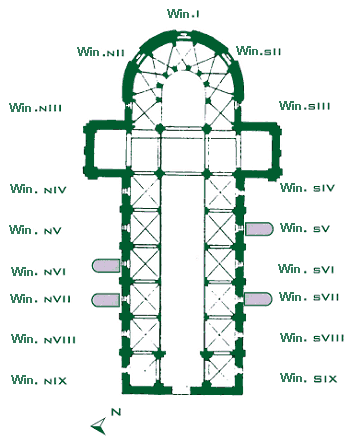
LOCATION: Window nVII - Riccialbani Chapel, begun around 1498. Two monks of the Cistercian order that had acquired this church belonged to the Riccialbani family.
DIMENSIONS: 270 x 200 cm.
PROVENANCE: original location
CHRONOLOGY: c. 1498-1500
AUTHOR: Giovanni di Domenico de’Vetri
PATRON: Riccialbani family
SUBJECT/S: Rhomboid pieces of colored glass form a pattern with colorless bull’s eyes. The rich border consists of flowers and fruit. At the center is a roundel with the Riccialbani coat of arms - a golden lion on an azure field. This medallion is enclosed in a chaplet created from the same flower and fruit motifs in the window’s border.
CRITICAL NOTES: Luchs confirms an attribution to the master glazier Giovanni de’ Vreti on the basis of payments to him; one for this window and the other "per 2 finestre fatte in choro a figure", windows she identifies with the Annunciation diptych now in Washington (see Foreign Collections/Washington National Gallery 1). This identification is supported by analogies between the decorative repertoire seen in the Riccialbani and Annunciation windows. Analogous border motifs are seen in the borders of Ghirlandaio’s apse window for S. Maria Novella. In R.K. Burnam’s volume on the stained glass windows in the Duomo of Pisa, a chapter devoted to fifteenth-century borders offers a preliminary investigation into the study of Tuscan borders (the focus of her book in progress).
In reiterating a main theme of her earlier work, Luchs (1988) emphasizes how the spatial placement of figures in the stained glass windows of Tuscan Renaissance churches may be related to the typology of Renaissance windows: curved, of modest proportions, clearly set off by bright walls. This typology (which became widespread in the lateral chapels of Florentine churches) started in S. Spirito’s Sacrestia Vecchia and in the Pazzi Chapel where, in a departure from Brunelleschian prototypes, the stained glass windows are, for the most part, composed of colorless bull’s eyes with a family coat of arms in the center. What is needed is a study devoted heraldic stained glass in Tuscany, a yet unexplored topic despite the considerable corpus of heraldic windows in existance.
CONDITION: In good condition despite some nineteenth-century interventions.
BIBLIOGRAPHY:
A. LUCHS Cestello. A Cistercian Church of the Florentine Renaissance, New York, 1977, pp. 116-118;
ID The Convent of Santa Maria Maddalena de’ Pazzi and its Works of Art, Florence, 1990, pp. 12, 15;
ID Western Decorative Arts, 1993, pp. 62-67, p.66, n.7;
R.K. BURNAM Le vetrate del Duomo di Pisa, Pisa, Scuola Normale Superiore, 2003
PHOTOGRAPHIC REFERENCE: CVMA-Italia archives
EDITOR: Renee K. Burnam, March 2003