 LOCATION:
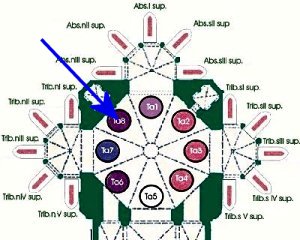
Firenze, S. Maria del Fiore Cathedral. Tamburo della cupola Ta8 (roundel)
| TUSCANY - Florence |
| FILE : Cathedral 7 |
| TITLE : Resurrection |
LOCATION:
Firenze, S. Maria del Fiore Cathedral. Tamburo della cupola Ta8 (roundel)
DIMENSIONS: diametre cm 480 c.
PROVENANCE: original location
CHRONOLOGY: 1443
AUTHOR: Paolo Uccello (cartoons – documented) execution (Bernardo di Francesco – documented)
ASSIGNEMENT: Opera del Duomo
SUBJECT/S : Resurrection. The subject is one of the Christological episodes included in the complex iconographic programme dedicated to the Glorification of the Virgin: the Annunciation (Ta – destroyed), the Nativity (Ta6), the Presentation at the Temple (Ta4), the Prayer in the Garden (Ta3), the Deposition (Ta7), the Resurrection (Ta8), the Ascension (Ta2). The sequence ends with the Crowning of Mary (Ta1), located in axis with the tribune, above St. Zanobi Chapel.
CRITICAL NOTES : when in 1436 Brunelleschi’s dome was almost completed, the Opera del Duomo wished to have the eight round windows of the tambour finished, closed with their relative stained-glasses. Those are the years when Ghiberti, after the three ocula in the counter-façade, was working at the Golden Gate of the Florentine Baptistery. That can justify why he did not fully dedicated himself to that glass complex. The assignment of the windows must have been quite laborious if the supervisors of the Cathedral Opera (the ‘Operai’) requested to Ghiberti and Donaltello, put into comparison, for the execution of the full-size and coloured cartoons of the Incoronation window, to be placed in situ in order to better verify their final effect (see Firenze Cattedrale 2).
A further comparison took place between Ghiberti and Paolo Uccello for another roundel, the one representing the Ascension : soon after his work at the Watch, Paolo Uccello was paid for the cartoon of that roundel on 2nd May 1443 but Ghiberti was favoured and obtained the commission (see Firenze Cattedrale 30). However, Paolo’s work must have been appreciated, as soon after he was assigned for the cartoons of other three roundels: the Resurrection (July 1443), the Nativity (November 1443), the Annunciation, (February 1444; window destroyed in 1828).
Martin underlines the quite large sum Paolo received, that is, 40 liras each cartoon, almost the same money paid for the frescos . Even if Paolo received less than what Ghiberti and Andrea del Castagno had ( 50 liras each cartoon) it is still a considerable payment if compared to the 64 liras he got for the Monument to Giovanni Acuto and the 40 for the Watch. Thus, The scholar concludes that Paolo as well, must have prepared the models for the full size roundels, with the painting of the background.
The three windows are an unusual work for Paolo Uccello, who was used to painting on canvas and at frescos. After his return to Florence from Venice in 1430, the artist dedicated himself to various cycles for decades: Stories of St. Francis at S. Trinita church, the decoration at the Assumption chapel in the Prato cathedral, recovered by Volpe in 1433-34; the Adoration of the Child fresco in St. Martin church in Bologna, dated around 1435 – but re-dated by the critics to an earlier period, before 1440 -; and the three compositions of the S. Romano Battle for Cosimo de’ Medici’s bedroom.
At S. Maria del Fiore yard the work went on: after the Monument to Giovanni Acuto, Paolo is busy at the Watch for the counter-façade paid to him in February 1443, a date near the assignment that will follow for the ocula of the tambour.
In that oculus , as in the other representing the Nativity (see Firenze Cattedrale 3) recur some figurative episodes already realized by Paolo in previous works. For this window the model is the S. Romano Battle (Firenze Uffizi); in the Resurrection, like in the Nativity one, the artist depicted rocky out crops in the side background and, beyond them, the far-away sky with its extending circles. The two soldiers with multi-coloured hats and the luxuriant plant with turgid fruit seem to be pieces taken by the cartoons of the Battle.
The execution of this oculus (as in the lost Annunciation) is a work by Bernardo di Francesco, with his almost square pieces of glass, close to the mosaic tessellatum, a characteristic that can be found in his Assumption , in the counter-façade, carried out years before.
CONDITIONS: Besides the continuous intervention made during the centuries that not always can be reconstructed from the sources, the cathedral windows have been recently restored by U. de Matteis of the Bruschi glass workshop (end XIX – beginning XX century) and by Ditta Tolleri (1946-57) that replaced lead frames and new tesseras often corresponding with important pieces of the window: in this case, the more remarkable remaking , carried out in the fifties, is the piece of Christ’s head.
The most recent intervention was realized by Prof. Papucci, of the Polloni Studio in Florence, together with A. Becattini and R. Cappelletti from March to December 1999.
The first step was to remove the panels form the cement support; tests made clear of a corrosion process in act on the outer sides of the glasses, together with the presence of deposits and crusts, at times with biotic elements (fungin). The deposits have been washed off with distilled water, compresses of E.D.T.A. and ammonium carbonate for the more resistant encrustings and with scalpel for the cavities created by the corrosion to protect the glass, a blend of heated linseed oil and beeswax was spread on the surfaces.
On the inner sides of the glasses, not damaged by corrosion, the deposits of smoke, first checking the grisaille, have been washed off with compresses of ammonium carbonate.
Working at the Apostles’ heads was more difficult as thy have double-glazing, filled in a previous restoration and painted as to integrate the features of the washed off faces on the original glasses. Such double-glazing caused the accumulation of dirt between the those and the original glasses and as a consequence, the figures’ faces became darker. The double-glazing were removed in order to clean the glasses, then put back as they were both still useful to the purpose and by now historically acquired. Furthermore, a new lead framing was placed in order to obtain pieces better soldered, that means also avoiding a further accumulation of dirt. Then, the lead framings have been cleaned up, the crevices soldered, together with a new outer framing .
All the broken tesseras have been glued and the webs provoked by the lead framing breaking have been taken off.
The broken tesseras have been stuck with U.V. ray photosensitive resins, occasionally with shaped pieces of colourless glass, and then painted without heating process. All the painting integrations are without heating.
The stained glass window has a frame and a counter-frame to protect and isolate it from external humidity, thanks to the isothermal glazing.
The whole work has been documented with reports, graphic and photos surveys, also with a scheme of the previous integrations according to CVMA conventions. From September to October 1999, before being replace, the window was showed in a temporary exhibition in the Cathedral , where the various stages of restorations were illustrated with descriptions and photos.
BIBLIOGRAPHY:
Sources:
G.POGGI Il duomo di Firenze, Firenze, (1909), ed. a cura M. Haines 1988, vol.I, nn747, 748, 749, 750.
Texts
H. VAN STRAELEN Studien zur Florentiner Glasmalerei des Trecento und Quattrocento, Wattenschad, 1938, pp. 81-83; G. MARCHINI Le vetrate italiane, Milano Electa, 1955 p.42, n.53; C.ACIDINI LUCHINAT Le vetrate, in AA.VV. La cattedrale di S. Maria del Fiore a Firenze, Firenze, 1995, vol. II, pp. 278-80; F. MARTIN- P. G.RUF Le vetrate di S. Francesco in Assisi, Assisi, 1998, pp. 132 –3.
Per l’attività di Paolo Uccello si veda A. ANGELINI Paolo Uccello in AAVV Pittura di luce, Milano, 1990, pp. 73- 84.
Per il regesto bibliografico dell’intero complesso di vetrate della cattedrale v. Bibl.Ghiberti
PHOTOGRAPHIC FILES: Archivio Electa Editrice, Milano
EDITOR: Caterina Pirina February 2001