 LOCATION:
Firenze, S. Maria del Fiore Cathedral.
| TUSCANY - Florence |
| FILE : Cathedral 8 |
| TITLE : Prophets and Forefathers |
LOCATION:
Firenze, S. Maria del Fiore Cathedral.
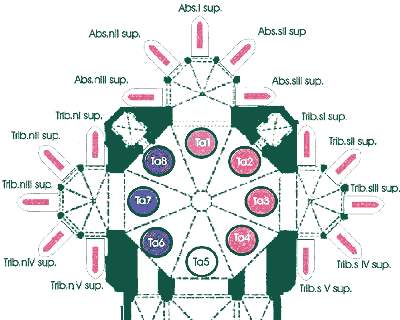
Tribunes windows (lancets): ApseI top – Apse nII top – Apse nIII top – Apse sII top – Apse sIII top – Trib. nI top – Trib. nII top – Trib.nIII top – Trib.nIV top- Trib.nV top- Trib. sI top – Trib sII. top – Trib.sIII top – Trib.sIV top Trib. sV top.
PROVENANCE: original location.
DIMENSIONS: not surveyed.
CHRONOLOGY: 1435-1439 (documented).
AUTHOR: various authors on Lorenzo Ghiberti’s cartoons.
ASSIGNEMENT: Opera del Duomo.
SUBJECT: The presence of biblical figures in the Tribunes and of Apostles and Saints in the chapels underneath refers then to the continuity between Old and New Testament, to which take part also the other Saints in the naves and in the ocula of the façade, together with – in the lower part of the chapels – other figures, not canons but recognized by the medieval hagiography according to the ‘summa’ in the Legenda Aurea by Jacopone da Varagine.
The complex is not only based on the figure of Mary but also on Christ, extreme Flower of Jesse’s tree and Lignum vitae, which also the same name of the cathedral seems to refer to (St. Bernard: Flos est Filius Virginis).
Besides, the prophets in the Tribune refer to that same theme. Moreover, Acidini Luchinat in addition to the prophets, and thanks to the fragmentary inscriptions, singled out even those of the kings of Judas (the crowned figures), and those of Christ’s Forefathers, according to Matthew’s and Luke’s Gospels (for example Abraham, Jacob, Booz, Obed, perhaps Jesse, David, Mattatia, Elizier, Er, Addi, Roboamo, Ioram, Azor, Sadoc, Josephat al.).
The series of Forefathers, a rare subject, together with the Prophets’, appears so as an introduction to the Incarnation theme. In one of the assignment documents there is an allusion to that theme, when the drawings are cited "…cum storiis generationis Virginis Mariae…"(Poggi), and the same fact that the window representing the Enthroned Mary with the Child among those with the Apostles and the Saints in the Chapels underneath.
As for the sixty figures of the Prophets, the exotic originality of their cloths, Ghiberti’s imagination in inventing their shape and, for some of the figures, the lively gesture-dialogue relation (similar to that of Donatello’s figures in the doors for the Old Sacresty of St. Laurence).
The stained glass windows lay out is the following: a-b 1 two figures in a setting seen in perspective open in the background in a mullioned window; a- b2 two figures with an architectonic background mullioned window-shaped.
CRITICAL NOTES: The windows of the Cathedral Tribunes belong to a Ghiberti’s mature period as a glazier. In fact, he had already made the three ocula on the façade with the Assumption (1405), St. Laurence and St. Stephen (1412-15), where the elegant and rich rhythms of the late gothic are more stressed (see Firenze,Cattedrale 6, 9, 10). Between 1435 and 1443 he carried out, together with other famous glaziers, the cycle for the Tribune (1435-1439) and for the Chapels (1439-1443), characterized by a more complex figures and space lay out (see Firenze, Cattedrale 15 –29). Then, between 1444 and 1445 projected three of the roundels of the dome (see Firenze, Cattedrale 4, 5, 30), the aim of his pictorial and artistic itinerary lived in total harmony with that of his career as a sculptor, and with comparable results.
The cycle of the Tribunes is linked to the Chapels’ – where the protagonists are the Apostles, the Saints, the Virgin and Child – by a similar iconic typology , with a clear distinction between the two ranks of the window: at the top there is still a gothic taste in the "setting" (here a mullioned window-like decoration, an umbrella-like vault ; in the Chapels, a sumptuous throne with canopy); at the bottom the protagonists are included in three-dimensional space by the simplified elements, and measured, because made with the linear perspective. Such doubleness well matches with Ghiberti’s complex culture, close to the tradition but often open to Humanism that will lead him, as in the Chapels windows, to anticipate the need of updating some medieval typological schemes, like the architectonic element of the canopy.
Compared to the windows in the Chapels, the ones in the Tribunes have been studied in detail also for the fact that it’s hard to identify the protagonists. Among the traditional contributions (Van Straelen, Paatz) Marchini’s stands out, sensible to a stylistic analysis and to the attribution matter, while among the more recent studies there are those of C. Acidini Luchinat (1994 and 1995), focusing on the iconography and identification of the protagonists.
The author traces the purpose of the original programme, aimed to celebrate Mary, in the whole work of the stained glass windows at S. Maria del Fiore, in a itinerary that starts from the Assumption of the façade to the Crowning of the dome.
As far as the style is concerned, for the two old men with oriental-like hats (trib. N. III top) Marchini suggested the autography of Maso Finiguerra – based on the analysis of the shapes of the bodies already known by Paolo Uccello and on the value of the constructive line , and thanks to comparisons with the figures of Amos and Isaiah carved in the wardrobes at the Sacristy -. Recently, the name of Maestro di S. Felicita, maybe identified with Mariotto di Cristofano, has been forwarded as the author of some drawings , for instance those for the figure bottom-left on window I of the Northern Tribune ((trib. n. I top) (see Acidini Luchinat).
Such collaboration seems also to include the windows of the Chapels: for St. John the Baptist window the author suggested is Giovanni dal Ponte (see Firenze, Cattedrale 19), Ghiberti’s follower and author of the oculus on the S. Croce façade (see Firenze, S. Croce 17), in the past it was attributed to Ghiberti as from what is written in his Commentari.
CONDITIONS: All the stained glass windows of the Cathedral underwent a through restoration by U. de Matteis of Bruschi’s laboratory (end XIX- beginning XX century) and by Studio Tolleri in Firenze (1946-1957). Many important pieces were replaced in order to achieve a correct reading of the work, as for example, the faces of the personages that, despite the mimic devices, can be recognized from the original context.
For further analysis of the windows condition and the extent of the damage on the surface and grisaille painting refer to more updated restorations.
BILIOGRAPHY: see Bibl. FIRENZE –GHIBERTI.
PHOTOGRAPHIC FILES:
EDITOR: Marina Del Nunzio (February 2001).