| TUSCANY - Florence |
| FILE : Cathedral 9 |
| TITLE : St. Laurence |
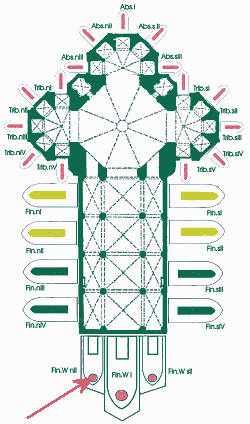
LOCATION: Firenze, S. Maria del Fiore Cathedral . Façade, window W n II (oculus).
PROVENANCE: original location.
DIMENSIONS:
CHRONOLOGY: 1412-15 (documented).
AUTHOR: Niccolò di Piero Tedesco on Lorenzo Ghiberti’s cartoon.
ASSIGNMENT: Opera del Duomo.
SUBJECT: St. Laurence enthroned surrounded by Angels. The window is framed by a bordure with floreal motifs.
CRITICAL NOTES: Ghiberti’s activity as a painter and as the artists of the cartoons for stained glass windows has not always been brought out. Yet, we know (Salmi) of his pictorial art education matured in a late gothic environment , with Mariotto di Nardo (Boskovits), a painter and an important master glazier (see Perugia, S. Domenico 1), and expressed in the lost frescoes for Malatesta at Pesaro. Ghiberti wrote in his Commentari "…l’animo mio alla pictura era in gran parte volto…" (‘… my nature to painting was mostly inclined…’) and his work can be located in that feeling of renovation in the Florentine culture of Giottesque tradition, between the XIV and the XV century; by artists that were attracted by the elegant, courtly but also expressive late gothic world.
Ghiberti’s ‘parallel’ carrier as a master glazier started in that context, and he will be the protagonist especially in the works at Cathedral for a long period of forty years: during that time, his style will be developing, in a way that can be compared to his other carrier as a sculptor, in which he was more famous, and that can be summed up into three main stages, corresponding with three groups of works.
The first stage is that of the ocula in the façade, where Ghiberti shows to be closer to the refined late gothic style. The second is that of Tribunes and Chapels stained glass windows (1435-43), where, besides the traditional elements, new special solutions a wider and more volumetric sense of the figure start to come out. The third is represented by the three ocula for the drum of the dome (1443-45), where there is a sense of new monumentality and solemnity. Such an evolutionary course is in harmony with what expressed by Ghiberti also as a sculptor, starting with the Northern Gate of the Baptistery and , through the works for Orsanmichele – more and more influenced by Donatello’s example – up to the Paradise Gate and his new and complex solutions both in the form and shape (see the episode of Salomon that meets queen Saba where the setting reproduces in perspective the interior of S. Maria del Fiore) that melts with the Master’s traditional rhythmic sensitiveness for the line.
The execution of the present window was given to Nicolò di Piero Tedesco, skilful master glazier , author of all the three façade’s ocula by Ghiberti, the Assumption in the middle (1405), St. Laurence and St. Stephen on the sides, all works cited by Ghiberti in his Commentari - "…disegnai nella faccia di S. Maria del Fiore l’occhio di mezzo con l’Assumptione di Nostra Donna e quelli (che) sono dallato…" (‘… I drew on the façade of S. Maria del Fiore the Assumption of Our Lady in the middle and the ones on the sides…’) – and that well represents the first stage of his evolution.
Both the two ocula with St. Laurence and St. Stephen have the same compositive scheme, with the titular saint sitting down on a fragile exedra-shaped throne surrounded by angels. They are also similar in the lay out of the image, based on the contrast between linear tension areas and more relaxed ones. The broken, taut and dynamic lines are concentrated in the peripheric areas (wings of the angels, back folding of the draperies), while in the central parts there is a slow unfolding of the ‘waves’ that recur in the Saint’s mantle.
Therefore, it’s clear how the scheme of the two ocula in the façade (see Firenze, Cattedrale 10) depends upon the one used ten years before in the oculus of the Assumption (see Firenze, Cattedrale 6), and how such works are homogeneous, coherent so that they represent the first stage in Ghiberti’s evolution. Other analogies can be found in the precious effect, in the use of unusual contrast of colours, in the difficult ‘carving’ work in order to obtain the floreal motifs of St. Laurence’s mantle, element that later will become one of the Master’s ‘signs’ in the chapels windows.
The same scheme of the work – and of the oculus with St. Stephen – recalls the later chapels windows, with the titular enthroned, his arm stretched out , supporting an attribute. Thus, the two twin windows on one side shows to belong to a particular stylistic period of the artist, on the other, they seem to preannounce the mature works of his second stage.
However, there is a difference in the figures between St. Stephen and St. Laurence windows. St. Stephen appears to be more thin, a figure almost hidden by the numerous folds of the mantle. On the contrary, the figure of St. Laurence is larger and the waving of the mantle appears to be less abundant and ‘abstract’. In fact, we know from the sources that the window very soon underwent some remaking, in 1423 and in 1432 – when a third of the glass tesseras were replaced – maybe due to the same Ghiberti (Marchini), driven by his intention to update the work according to his stylistic evolution, gradually reaching a more considered but not less complex use of the line in relation to the volume of the figure, so as there is evidence in a sculpture, his almost contemporary St. Stephen for Orsanmichele (1425-28).
CONDITIONS: The cathedral windows underwent continuous damages and maintenance works. There is prove of that in the remaking maybe made by Ghiberti himself on this window in 1423 and 1432. Besides those interventions there are others on the side ocula carried out by Francesco di Giovanni named ‘il Lastra’ and Bernardo di Francesco, two famous master glaziers already active since 1418 in the restoration of the naves windows and then cited as the artists of Ghiberti’s windows in the transept Tribunes and Chapels and for those – again lead to Ghiberti – realized for the third glazing activity at Orsanmichele (Finiello Zervas).
The two main restorations were carried out by U. de Matteis between the XIX and the XX century and by Ditta Tolleri in the post-war period (1946-57). To those interventions is due the most part of the lead framing replacing, of the glass tesseras and some important pieces in the reading of the work, such as hands and faces of the figures.
As shown in the recent restorations carried out in the last years at the Chapels and the dome windows by Studio Polloni in Florence, the outer sides of the glasses manifest the corrosion in act due to impurities and to humidity. The same surveys and care are likewise advisable also for this façade windows in order to prevent their deterioration, through the recovering of the surfaces and their protection with counter-windows to create an isothermal glazing.
It is advisable also an analysis of the deterioration state of the grisaille painting, that in various parts appear to be faded away, with a consequent impossible reading of the figures; especially the faces of the Angels.
The cracked tesseras also should be recomposed, more cracked here than elsewhere, and the lead webs of containment should be eliminated – especially the ones that cut the faces or the necks of the Angels - followed by painting integrations are without heating , and furthermore, the mapping of all the replaced tesseras in the previous restorations referred to the graphic of the lead framings planning.
BILIOGRAPHY: see Bibl. FIRENZE –GHIBERTI.
PHOTOGRAPHIC FILES: Archivio Electa Editrice, Milano
EDITOR: Marina Del Nunzio (December 2000).